Barnett Research Group
Northwestern University
Our group focuses on energy and advanced technology applications through the investigation of solid oxide fuel cells and transparent oxide semiconducting thin films. In each case, the materials are created in-house via colloidal deposition, sputter deposition, and other ceramic processing techniques.
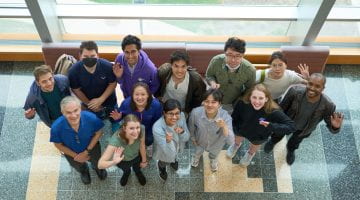
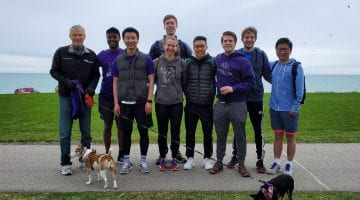
The Barnett Group and Friends. From left to right: HyungDae Jin, Sungmee Cho, Zhao Liu, Danni jin, Beth Miller, Andy Wilson, Andrea Fowler, Dan Fowler, Ann Call, Scott Cronin, Kyle Yakal-Kremski, Tim Flavin, Kun Woo Jun, Scott Barnett, Piper Barnett, Alex Cunliffe, Thomas Yu, Gareth Hughes
Solid Oxide Fuel Cells:
Solid-oxide fuel cells can provide pollution-free, efficient electricity generation. Our thin-film approach allows cell operation at much lower temperatures than do conventional bulk devices. We are studying the effects of electrode structure and composition on electrochemical fuel and oxygen reactions by use of different processing techniques, electrochemical modeling, and quantitative three-dimensional structural analysis. Work is also focused on new anode materials for use with hydrocarbon fuels such as natural gas and propane. Electrode degradation via coarsening of Ni in anodes and structural and chemical changes in LSM-YSZ cathodes is also being studied.
Transparent Oxide Semiconductors:
Transparent oxide semiconductors (TOS) are integral parts to photovoltaic devices, flat panel displays, and touch screens. Current problems in this field include a lack of p-type material and the high cost of existing materials. To provide solutions to these problems we are investigating novel p-type thin films, with an end goal of an all-oxide transparent transistor. We are also attempting to eliminate the need of high-cost single crystal substrates by depositing biaxial oriented films onto amorphous substrates. We use dc reactive sputtering to deposit our thin films and x-ray diffraction, AFM, SEM, electrical measurements, and optical measurements to characterize them.